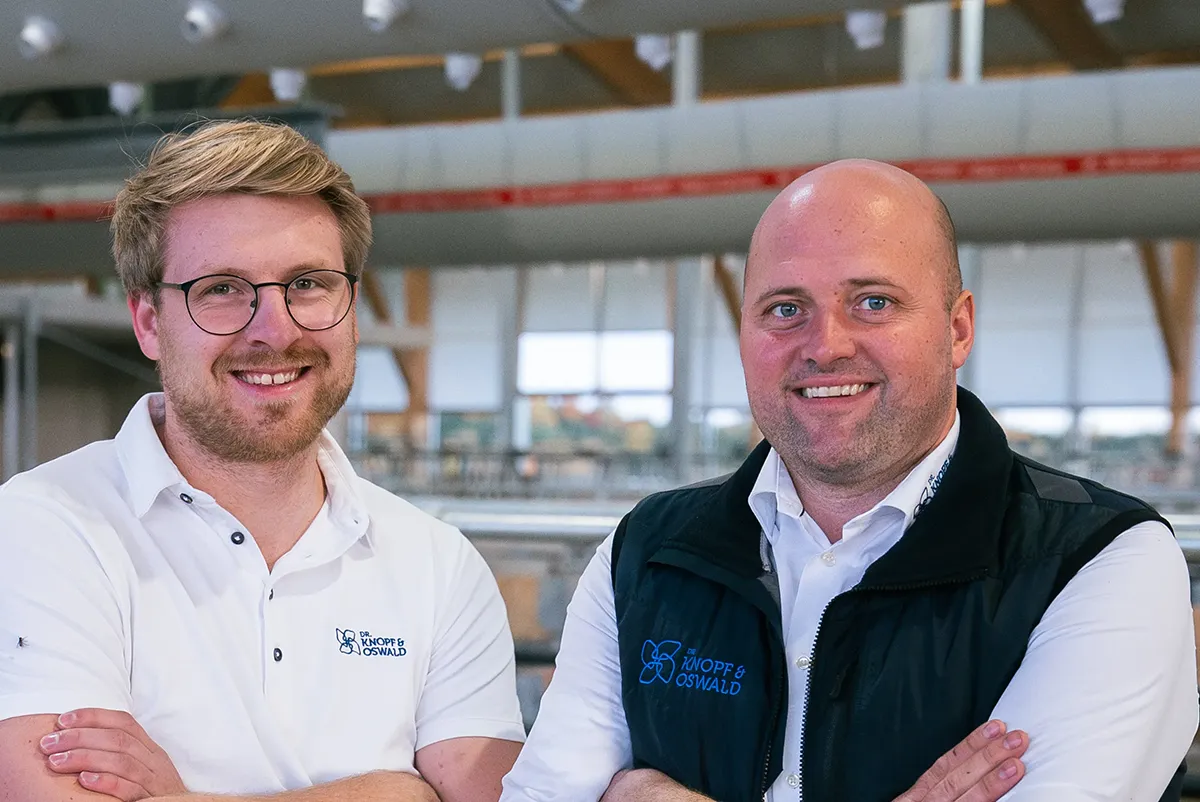
STallbelüftung: Weniger Hitzestress und mehr Tierwohl im Milchviehstall
Individuelle Schlauchbelüftung für einen nach Süden ausgerichteten Liegebereich
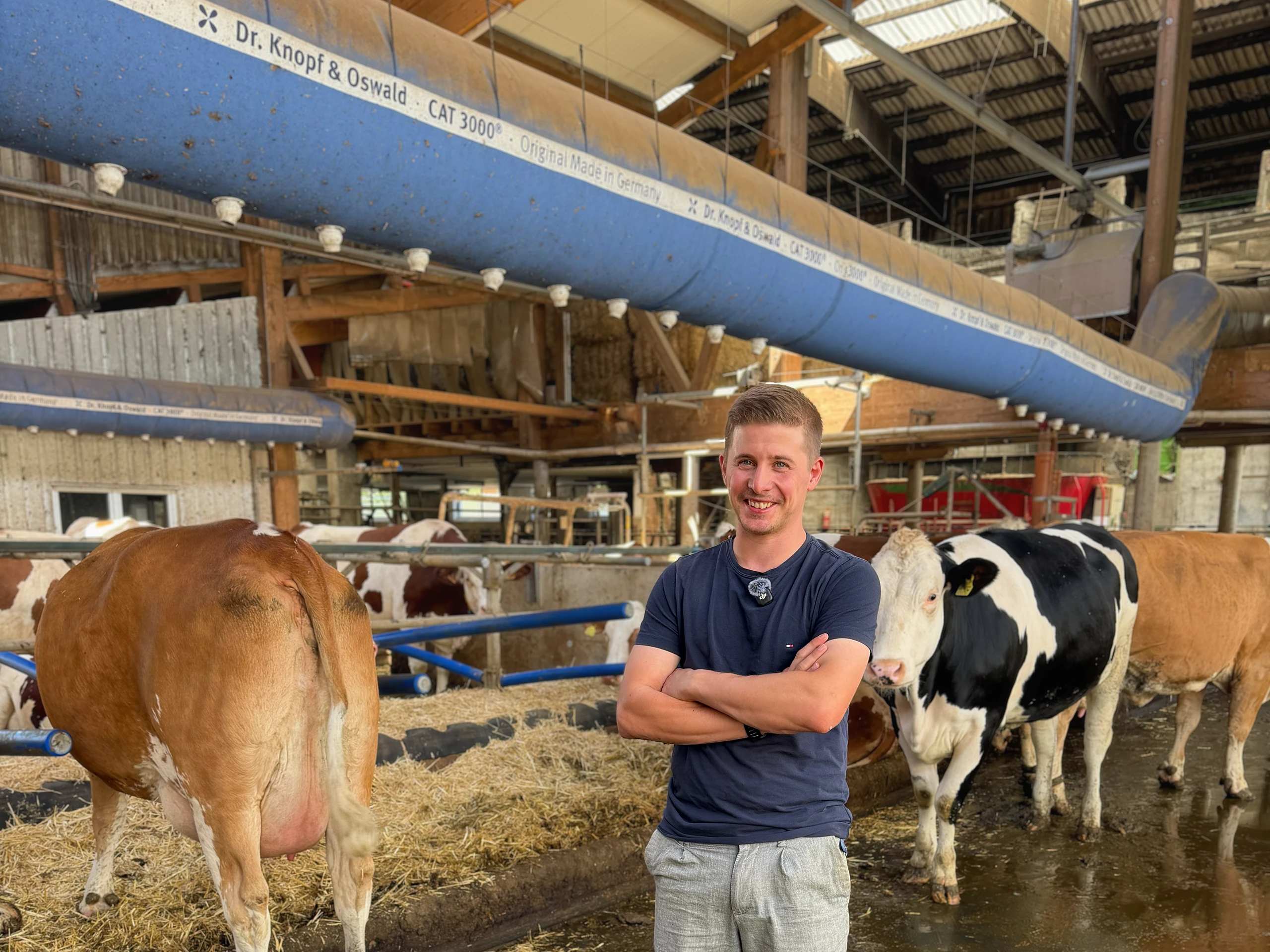
Der Milchviehbetrieb von Lukas Hörandner in Gaisberg, Schernham, wurde 2020 umgebaut und bietet heute Platz für rund 60 Milchkühe. Bereits kurz nach dem Umbau zeigte sich, dass sich der nach Süden ausgerichtete Liegebereich im Sommer stark aufheizte. Trotz geöffneter Seitenwände und eines ausfahrbaren Lichtfirsts war die Luftbewegung nicht ausreichend, um den Hitzestress der Kühe wirksam zu reduzieren.
Deshalb entschied sich der Betrieb 2021 für eine Schlauchbelüftung von Dr. Knopf & Oswald.
Die Anlage wurde gezielt auf den besonders warmen Liegebereich abgestimmt. Über drei Lüfter werden die rund 60 Liegeplätze mit Frischluft versorgt. Durch die Anordnung der Düsen wird die Luft gezielt in den Aufenthaltsbereich der Kühe geführt und sorgt dort für eine deutlich stärkere Luftbewegung.
„Nach dem Stallumbau war uns klar: wir brauchen eine Belüftung im Stall, weil es für die Kühe einfach extrem heiß wird“, berichtet Lukas Hörandner.
Weniger Hitzestress – Leistung bleibt auch im Sommer stabil
Für den Betrieb war die Belastung durch die Sommerhitze ein entscheidender Grund für die Investition. Vor der Installation führte der Hitzestress dazu, dass die Kühe im Sommer weniger Leistung brachten und häufiger gesundheitliche Probleme auftraten.
Seit der Installation der Schlauchbelüftung hat sich die Situation deutlich verbessert. Auch bei Temperaturen von bis zu 40 °C fällt die Milchleistung im Sommer nach Aussage des Betriebs kaum noch ab. Gleichzeitig beobachtet Lukas Hörandner deutlich weniger Probleme mit Mastitis und Stoffwechselstörungen.
„Die Kühe sind einfach fitter und gesünder. Wenn sie fitter und gesünder sind, dann ist auch mehr Milch im Tank.“
Auch beim Liegeverhalten zeigt sich der Unterschied. Vor der Installation hielten sich die Kühe an heißen Nachmittagen kaum noch im Liegebereich auf. Heute kommen sie nach besonders heißen Phasen schneller wieder zurück und nutzen die Liegeflächen vor allem am Abend wieder deutlich stärker.
Ein weiterer Vorteil zeigt sich in besonders heißen Nächten: Wenn die Temperaturen kaum unter 30 °C sinken, sorgt die Anlage auch nachts für Kühlung und ermöglicht den Kühen, ihre Körpertemperatur besser abzugeben und sich zu entspannen.
Kühlung genau dort, wo sie gebraucht wird
Die Schlauchbelüftung ist temperaturgesteuert und passt die Luftmenge automatisch an die Außentemperatur an. Je höher die Temperatur steigt, desto stärker wird die Luftbewegung.
Neben dem Liegebereich wurden zusätzliche Düsen über dem Melkroboter und im Vorwartebereich installiert. Gerade während der Sommermonate bietet dies einen zusätzlichen Vorteil: Die Luftbewegung hält Fliegen vom Rücken der Kühe fern und sorgt dadurch für ruhigere Bedingungen beim Melken.
Auch die Kühe nutzen den angenehm kühlen Bereich gerne. Die gezielte Kühlung im Melkroboter trägt dazu bei, dass die Tiere diesen Bereich gerne aufsuchen.
Individuelle Planung trotz schwieriger baulicher Voraussetzungen
Eine besondere Herausforderung bei der Planung war die Lage des Stalls. Nur wenige Meter vom Stall entfernt befindet sich das Wohnhaus des Nachbarn. Herkömmliche Ventilatoren auf dieser Seite wären insbesondere bei hoher Leistung mit einer entsprechenden Geräuschentwicklung verbunden gewesen.
Gemeinsam mit Christian Oswald wurde deshalb eine individuelle Lösung entwickelt: Die Luft wird auf der gegenüberliegenden Seite des Stalls angesaugt. Dort befinden sich die Lüfter im Schatten, sodass nicht die bereits aufgeheizte Luft angesaugt wird.
Auch die Leitungsführung wurde individuell auf den Stall abgestimmt. Ein Schlauch wurde über den Melkroboter geführt, sodass die Kühe auch während des Melkens mit kühler Luft versorgt werden können.
Für Lukas Hörandner war gerade diese individuelle Planung ein wichtiger Entscheidungsgrund: „Die Beratung und wie er das installieren wollte, wie wir sie auch im Endeffekt installiert haben, hat mir einfach bei Dr. Knopf & Oswald am besten gefallen.“
Eine Investition, die sich für den Betrieb rechnet
Nach mittlerweile fünf Sommern im Einsatz ist Lukas Hörandner überzeugt, dass sich die Investition bereits bezahlt gemacht hat. Weniger gesundheitliche Probleme, weniger Tierarzt- und Medikamentenkosten und eine stabilere Leistung während der heißen Monate tragen aus seiner Sicht zur Wirtschaftlichkeit der Anlage bei.
Gerade während der arbeitsintensiven Erntezeit ist es für ihn wichtig, sich auf gesunde Tiere verlassen zu können: Wenn die Kühe fit sind und im Stall alles läuft, bleibt mehr Zeit für die Arbeit auf dem Feld.
„Mehr Leistung, mehr Milch im Tank, es rechnet sich einfach.“
Auch rückblickend würde er sich wieder für die Schlauchbelüftung entscheiden. Für ihn gehört eine funktionierende Belüftung heute zu einem modernen Milchviehstall mit leistungsfähigen Kühen dazu.
Kundenstimme:
„Hundertprozentig würde ich mich nochmal für die Schlauchbelüftung entscheiden. Das war eine der besten Investitionen, die wir im Stallbau getätigt haben.“
Give us a call,
We are always there for you
and advise you personally: +49 8092 853804-0,
or via our inquiry form:
For which animal species and applications is hose ventilation suitable?
We use hose ventilation for all conceivable animal species and special applications:
Cattle, sheep, goats, poultry, rabbits, pigs, horses, etc.
When designing the system, we take into account the health-safe air speed on the animal. As our systems are individually manufactured, we can cater to almost all special requests and special applications of our customers. With upstream air heaters or heat exchangers, heat-loving animal species can also be supplied with absolutely fresh air.
If your application is not listed here, simply ask us - we will find a solution. Our ventilation system can ventilate almost anything and can be configured so individually that it can be integrated almost anywhere - for example, our hose now also helps with the fresh air storage of sensitive organic cereals in high racks or with reducing humidity in the halls of a fish farm.
Can hose ventilation be combined with built-in ventilation systems?
The CAT 3000 hose ventilation system can be combined with various built-in or natural ventilation installations. If your barn already has an underfloor extraction system, for example, the system can be combined with it. Of course, the CAT 3000 can also be operated in combination with natural ventilation systems: In this case, the system can successfully compensate for seasonal differences in function - e.g. when there is no wind or no air can rise through the ridge due to the weather conditions. Please state your existing ventilation equipment in the inquiry form. We can then take these into account in your non-binding inquiry!
What does the name "CAT 3000" mean?
"CAT" is the abbreviation for "Clean Air Transport".
Does the barn ventilation have a control system?
Yes, we always equip our ventilation systems in stables with a 5-stage control system.
The ventilation output is calculated precisely for your barn and set to one level of the controller - as the "continuous operating level". In this setting, fresh air is supplied to the animals all year round. In the summer months from 25 °C, the system has an additional reserve for "summer operation". The air exchange rate can thus be increased in order to achieve an additional climate improvement in very hot weather.
What width does the hose ventilation cover?
In terms of width, the hose ventilation can supply approx. 7 meters of fresh air from the center point to both sides.
What is the maximum length of the hose ventilation?
The maximum length of the ventilation hose is approx. 50 meters. If a longer distance needs to be bridged, the system can be extended by a second system from the opposite side up to a total of 100 meters.
Depending on the ceiling height, it may also be possible to increase the diameter of the hose in order to supply fresh air to a distance greater than 50 meters. However, this option must be assessed on a case-by-case basis.
How much does a hose ventilation system cost - Price?
As every stable is a little different, we need a few details from you to make a non-binding offer. Simply complete the online inquiry form and send it off. We will send you a non-binding offer for your project within the next few days. If you are happy with our offer, one of our employees will visit you, take the dimensions of the barn and determine the position of the fan.
Can I install the barn ventilation myself?
After our quotation, the measurement and your order placement, you will receive all the individual components of the hose ventilation system. You can install these yourself using simple instructions. Once an electrician has established the power connection, the system can be put into operation immediately.
How long does the fabric of the ventilation hose last?
Our manufacturer specifies a service life of over 10 years for the material. The same material has been used in cheese dairies for over 12 years and is washed once a week for hygiene reasons.
The fabric is woven from special polyester yarn. It is washable and resistant to ammonia and harmful substances.
The air holes are laser-cut. This means that the edges are immediately fused in the cut and do not fray during washing.
Is condensation forming on the hose?
NO, condensation does NOT form on our ventilation hose.
To avoid condensation, we have opted for an air-permeable textile fabric for the hose material. As the fabric is constantly permeated with air, there is no surface on which humidity can condense.
Condensation can only form if the material of the hose is made of airtight material (e.g. airtight fabric, coated fabric, plastic film, etc.). The condensation then runs down the hose and drips off. Due to the permanent moisture, the hose quickly becomes covered in algae - as can be seen in the picture below. The picture shows a ventilation hose whose fabric has an airtight coating. You can see the water running down and dripping off. A green film of algae has formed on the top of the hose.
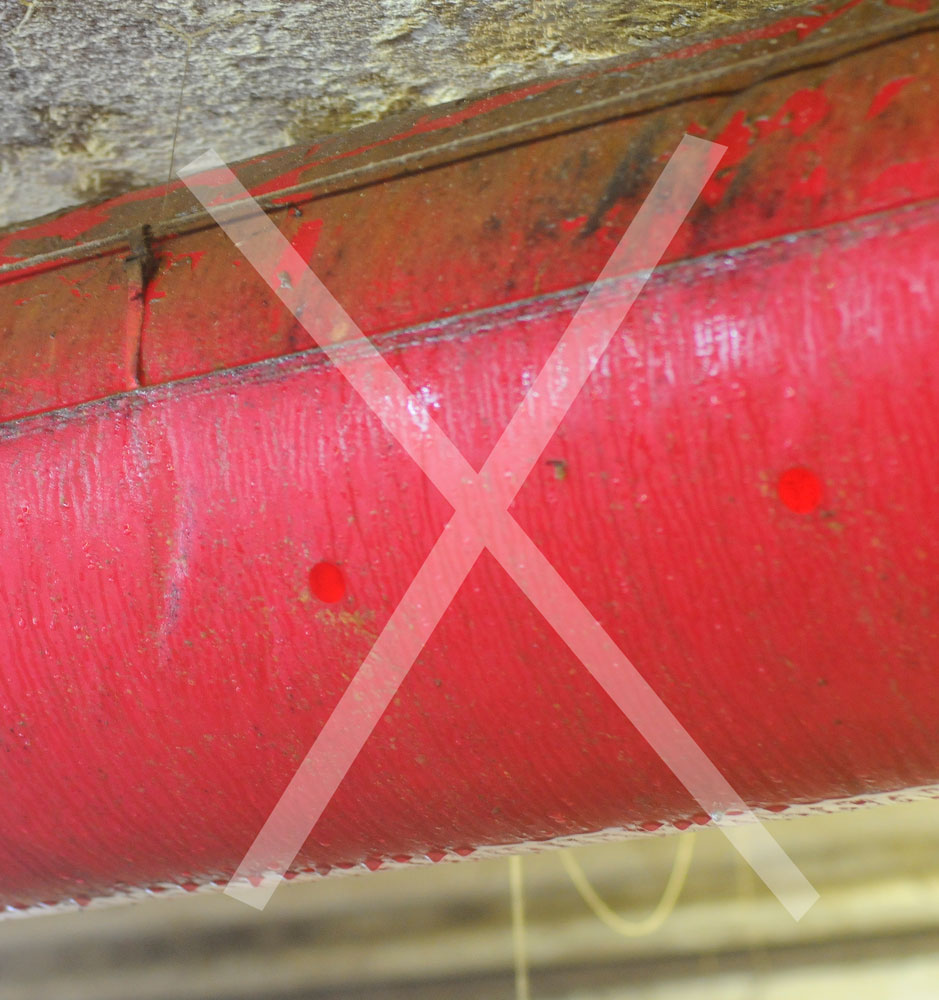 The material we use is easily permeable to air. You can therefore be sure that our ventilation hose will not "sweat" and that no condensation will form on the surface.
Wash and disinfect hose ventilation
The ventilation hose can be easily washed and disinfected. It can be divided into manageable pieces with zippers.
For effective disinfection, we recommend either washing with a disinfectant detergent in powder form in the washing machine or disinfection using an immersion bath (after prior washing).
Washing temperature: 40 degrees.
Do not wash above 40 degrees!
We offer a suitable detergent for simultaneous disinfection:
1:5 liquor ratio (ratio of laundry to water)
40g per kg capacity of the washing machine
Minimum main wash time at 40°C: 20 minutes
VAH-listed detergent for chemothermal laundry disinfection at 40°C. Excellent washing performance and stain removal.
Effectiveness: Disinfection procedure according to the Association for Applied Hygiene - VAH, the Robert Koch Institute - RKI (procedures registered for listing) and individual certificates:
Verbund für angewandte Hygiene (VAH): Bacteria (incl. MRSA, VRE, MRGN), yeasts
Robert Koch Institute (RKI) AB (registered): A: Bacteria, mycobacteria, yeasts; B: Viruses
Sporicides (full sporicidal efficacy according to Eurostandard EN 13704): Spores: Bacillus subtilis, Bacillus cereus, Clostridium difficile
Disinfection in the immersion bath
We offer a suitable disinfectant for carrying out disinfection by immersion:
Immersion bath after prior cleaning at min. 20°C, max. 40°C
Application time: 20 minutes
Dosage: 1%
Excellent microbiological efficacy (tested in accordance with EN 1276, EN 13697, EN 1650).
Free from chlorine, phosphates and aldehydes.
Microbiologically effective against:
Candida spec.
Aspergillus spec.
Enveloped viruses
Newcastle disease, paramyxovirus
Infectious bronchitis, coronavirus
Bluecomb disease, coronavirus
Infectious laryngotracheitis, herpes virus
Marek's disease, herpes virus
Classical avian influenza, orthomyxovirus
Avian leukosis, retrovirus
Avian sarcomatosis, retrovirus
Fowlpox, Poxvirus
Unenveloped viruses
Avian encephalomyelitis, picornavirus
Infectious Bursal disease /Gumboro, Birnavirus
Stunting syndrome, parvovirus
Avian adenovirosis, adenovirus
Egg drop syndrome, adenovirus
Bacteria
Mycoplasmosis: Mycoplasma species
Fowl typhus, Salmonella gallinarum pullorum
Poultry cholera, Pasteurella multoida
Enveloped viruses
Classical swine fever, Togavirus
TGE, coronavirus
Aujeszky's disease, herpes virus
Influenza, myxovirus
PRRS, Arterivirus
Vesicular stomatitis, rhabdovirus
Unenveloped viruses
Foot and mouth disease, picornavirus
Teschen disease, picornavirus
Vesicular disease, picornavirus
Vesicular exanthema, calicivirus
Parvovirosis, parvovirus
bacteria
Leptospirosis, Leptospira interrogans
Atrophic rhinitis, Bordetella/ Pasteurella species
Brucellosis, Brucella suis
Salmonellosis, Salmonella species
Dysentery, Treponema hydrodysenteria
Erysipelas, Erysipelothrix rhusiopathiae
Contagious plueropneumonia, Haemophilus pleuropneumonia
Enveloped viruses
Vesicular stomatitis, rhabdovirus
"Rinderpest", paramyxovirus
Lumpy skin disease, poxvirus
Rift valley fever, Bunyavirus
Bovine leukosis, retrovirus
Infectious rhinotracheitis/vulvovaginitis (IBR-IPV), herpes virus
Mucosal disease, Togavirus
Unenveloped viruses
Bovine adenovirus, adenovirus
Foot-and-mouth disease, picornavirus
Bacteria
Contagious pleuropneumonia, Mycoplasma mycoides
Mycoplasma mastitis, Mycoplasma bovis
Leptospirosis, Leptospira interrogans
Brucellosis, Brucella species
Genital camphylobacter, Camphylobacter species
Dermatophilosis, Dermathophilus congolensis
Hemorrhagic septicemia, Pasteurella multacida
Salmonellosis, Salmonella dublin
Mastitis agalactica, Steptococcus agalactica
Enveloped viruses
Plague of small ruminants, morbillivirus
Rift valley fever, Bunyavirus
Nairobi sheep disease, Bunyavirus
Smallpox, poxvirus
Cold sores, poxvirus
Maedi / Visna, Retrovirus
Pulmonary adenomatosis, enveloped viruses
Unenveloped viruses
Foot-and-mouth disease, picornavirus
Bluetongue disease, reovirus
Bacteria
Dermatophilosis, Dermathophilus congolensis
Brucellosis, Brucella species
Contagious agalactica, Mycoplasma agalactica
Salmonellosis, Salmonella abortus ovis
Listeriosis, Listeria
Atrophic rhinitis, Pasteurella multocida
Enveloped viruses
Vesicular stomatitis, Rhabdovirus
Infectious anemia, Retrovirus
Equine influenza, Orthomyxovirus
Rhinopneumonitis, Herpesvirus
Smallpox, Poxvirus
Equine viral arteritis, Togavirus
Equine encephalomyelitis (WEE, VEE, EEE), Togavirus
Non-enveloped viruses
African horse sickness, Reovirus
Bacteria
Dermatophilosis, Dermatophilus kongolensis
Contagious metritis, Taylorella equigentalis
Glandes, Pseudomonas mallei
Equine salmonellosis, Salmonella abortus equi
Strangles, Streptococcus equi
Mellioidosis, Pseudomonas pseudomalei
We will be happy to make you an offer.
We will be happy to send you the washing instructions and washing order on request.
How does the installation work?
We supply you with all the components you need to install the fan, the weather protection hood (optional), the control unit and the ventilation hose. The fan and cable suspension are easy to install.
As a wall opening in load-bearing walls interferes with the statics of the house, we always recommend consulting a structural engineer. If necessary, installing a lintel over the opening can solve the problem easily. If nothing stands in the way of the breakthrough, it can be carried out manually or with a core drill (by a specialist company).
Once the opening has been created, the matching wall duct supplied is fitted flush into the wall. It seals the masonry cleanly and prevents air turbulence in front of the fan thanks to its smooth surface.
The fan and control unit may only be connected to the power supply by an electrician.
The fan and the cable suspensions are attached with dowels. Pay attention to the routing of cables (electricity/water/gas etc.)!
Once everything is ready, the ventilation hose can simply be hooked into the tensioned ropes using clips. The hose is connected to the fan with a hose clip. Once all the components have been installed, the system can be put into operation.
What is the process from planning to installation?
Procedure:
- You will receive a non-binding offer from us after submitting the inquiry form.
- If you are happy with our offer, we will come to you to discuss and measure the structural situation on site. We will add the cost of this to the purchase price when you buy the hose ventilation system.
- Once we have received your order, we manufacture your individual ventilation duct exactly according to our measurements. We also put together suitable fans, wall ducts and installation materials.
- You will be informed of the dimensions of the wall opening for the structural preparation.
- After testing the hose aeration system at our premises, during which we check and readjust the function and flow rate of the air at animal height, among other things, we pack and ship your CAT 3000 hose aeration system.
- The enclosed installation instructions make it easy for you to install the hose ventilation system.
- The hose ventilation is connected by an electrician.
- And the CAT 3000 hose ventilation system can be put into operation immediately.
What colors is the stable ventilation hose available in?
The standard color of the hose ventilation is light grey. For colorful accents, it can also be supplied in red, yellow, blue or black.
Does the hose ventilation run all year round?
Yes, the hose ventilation runs constantly all year round, 24 hours a day, 365 days a year. Only on very hot days in summer can the air exchange rate be gradually increased on the control unit for an additional cooling effect.
Does the hose ventilation also work in winter?
Yes, in any case. As all barn doors and openings are often closed in winter, barns without ventilation have a high level of humidity (recognizable by condensation on the windows). The humidity is greatly reduced by the CAT3000 hose ventilation system. Clean, dry fresh air always flows into the barn. This is always healthier than damp stable air enriched with germs and ammonia. In addition, lying comfort is increased by drier straw.
Our ventilation hose is made of slightly air-permeable fabric. This prevents condensation forming on and in the hose - especially in winter.
How long does it take to install the hose ventilation?
With a system of 15 meters, the installation of the barn ventilation takes approx. 5-6 hours (without wall breakthrough and electrical installation).